Lightmain is now a Made in Britain member. Here’s what it means for you
Made in Britain
Our MUGAs, playground equipment, goal ends, posts and street furniture now carry the official Made in Britain mark. This is what the mark is and why it matters if you're buying for a school, council or park.

Somewhere in the tender on your desk there’s a box asking where the product is made. Most buyers fill it in from whatever the supplier’s brochure says and trust that it’s true. From today, with us, you don’t have to. Every piece of steel sports and play equipment we fabricate in South Yorkshire now carries a registered trademark that backs the answer up. Lightmain is a licensed member of Made in Britain.
We’ve actually been manufacturing in the UK for a long time. Our roots are in heavy-duty steel for the South Yorkshire mining industry, and when mining declined we turned the same skills and the same habits to sport, play and street furniture. That was over 25 years ago. Equipment built for a coal mine has to stand up to far worse than a school field, and that’s still the standard we build to. So the way we work hasn’t changed. What has changed is that you no longer have to take our word for it.
What the mark actually checks
Made in Britain is a collective trademark registered with the UK Intellectual Property Office, licensed only to members, and the organisation can ask any member for written evidence of where its products are made. Members sign a code of conduct, and the mark can only go on products made in Great Britain or Northern Ireland.
What carries the mark
Everything we design and fabricate ourselves in South Yorkshire:
- Multi-Use Games Areas (MUGAs), heavy-duty and medium-duty
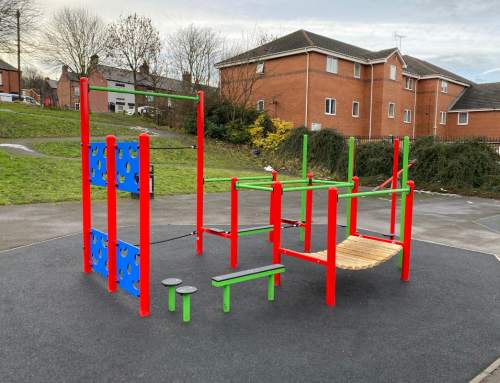
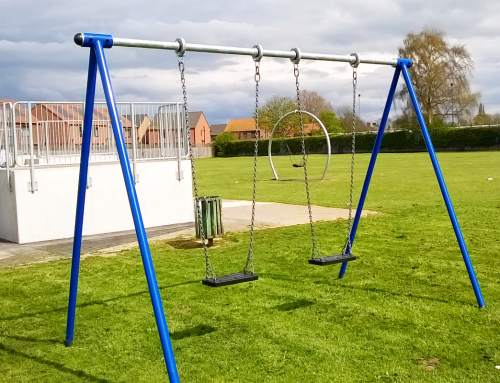
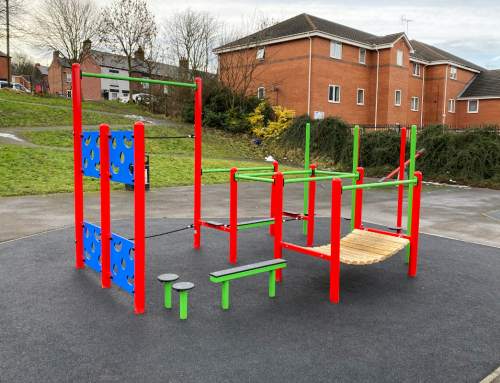
- Playground equipment: Playground Climbing Frames (Toddler, Junior and Intermediate), trim trails and swings
- Goal ends and ball walls
- Basketball and netball posts, including the dual rotating post
- Youth shelters and street furniture
- Skate park equipment
The heavy-duty products in that list come with our 25-year guarantee, the way we’ve always done it. There are photos of most of them on our projects page.
What it changes when you’re writing a tender
If you buy for a council or parish council, a school or academy trust, or you’re a contractor pricing a tender that specifies our products, country of origin is now a question buyers are expected to answer.
Take the four parts of a typical tender where it comes up:
Procurement rules
Since February 2026, local authorities in England have been able to reserve competitions for below-threshold contracts to UK or local suppliers under the Procurement Act 2023. Councils don’t have to use it, but where they do, a verified UK manufacturer is a much easier line to defend than a supplier who simply says so.
Social value
Spend with a UK manufacturer stays in the UK economy, which is what the social value section of a tender asks you to show.
Accountability and after-care
Most tenders ask who is responsible for the equipment once it’s installed, and for how long. With an imported product that answer runs through an importer. With a UK manufacturer there is no middle step. The company that designed and made the equipment installs it, and it’s the company you ring in year 15 when something needs fixing.
Whole-life cost
Price carries the most weight in any tender, and the price that matters is the one over the life of the facility. Heavy-duty steel fabricated here, galvanised and guaranteed for 25 years costs more on day one than imported timber or plastic, and less over the 25 years that follow. The mark is one more piece of evidence for the finance committee.
Why making it here still matters
Plenty of the equipment offered to UK schools and councils is made abroad, and for a long time that was the cheap option. The last few years have changed the sums. In Make UK’s supply chain survey with Infor, 93% of manufacturers said the pandemic had disrupted their supply chains, 74% pointed to transport costs, and three-quarters had added British suppliers in the previous two years.
The wider case is easy to put in numbers. UK manufacturing provides 2.6 million jobs that pay 8% more than the economy as a whole. Every £1 it generates supports another £1.80 elsewhere, and 56% of people think their local area would be worse off without it.
For a buyer, that lands in practical ways. A shorter supply chain has fewer things that can delay it. The people who made the equipment are the people you ring when something needs looking at. And the money stays in the UK economy, which is the point of the social value question.
What hasn’t changed
We design, manufacture, install, inspect and maintain, as one team. We’re still Constructionline Gold, CHAS accredited and SAPCA members, an ESPO supplier and Disability Confident Committed, with RPII-qualified inspectors in-house.
The Made in Britain mark doesn’t make the steel any stronger (if that is even possible). What it does is make it easier for you to prove where the steel came from.
See it for yourself
If you’re comparing suppliers for a MUGA, play area or sports equipment, book a free, no-obligation consultation. We’ll give you straight answers on cost and on what lasts.